How Much Money Does It Take to Remove an Inground Pool?
If you're asking how much money does it take to remove an inground pool, the answer depends mostly on three things: whether the shell is broken up and filled in place or hauled out completely, how easily equipment can get into the yard, and how much broken shell, decking and fill the job involves. Those three decide most of the bill. Permits, utility work and the spa or equipment pad next to the pool add to it from there.
Instead of a national average that may have nothing to do with your yard in Boise, Meridian or Nampa, here's what a real on-site estimate prices.
How much money does it take to remove an inground pool?
The money it takes comes down to how much of the pool leaves the property and how hard it is to get it out. An above ground pool is a much lighter job, since it's mostly a frame and a liner. A ground pool built into the yard is a different project.
A small in-ground pool with open access and little decking sits at the low end. A big one behind a narrow gate, with a wraparound deck and an attached spa, sits at the high end.
Good to know: There isn't really an average pool. That's why a crew needs to stand in your backyard before giving a firm price.
Here's how the work usually breaks down.
Partial removal: break the top down and fill it in place
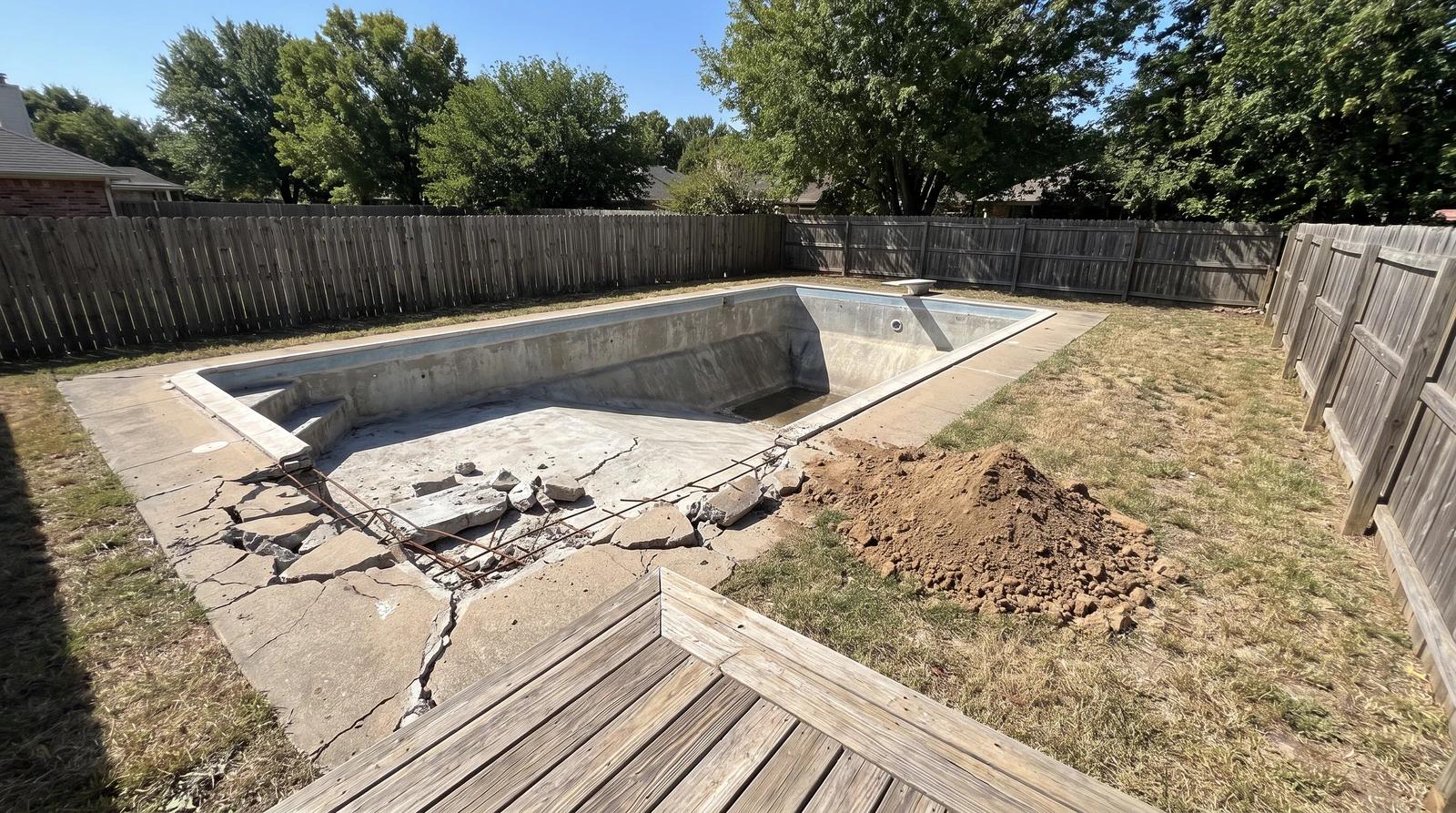
This option means the crew drains the in-ground pool, punches drainage holes through the floor, breaks the top section of the walls down into the pool cavity, and fills the rest with clean fill and topsoil. Most of the pool shell stays buried.
It's less breaking and less hauling than full removal, so the pool removal cost tends to come in lower. The tradeoff is that you've got old shell pieces in the ground under your yard.
Some buyers and lenders ask about that, and you may need to disclose it when you sell. Building on that spot later can get complicated too.
Full removal: break out the whole shell and haul it away
Here the whole shell comes out: walls, floor, steel and all. The hole gets backfilled in layers and compacted, so the ground behaves like normal soil again.
It's more demolition, more hauling and more fill, so it costs more. But nothing's left behind. That's the version people usually want if they're thinking about a patio, a garden, an addition or selling in the next few years.
The extras that come with it: decking, equipment pad, fencing and lines
The pool itself is only part of the job. A lot of backyard swimming pools come with:
- A concrete or paver deck around the edge
- An attached spa, or a separate hot tub nearby
- A pump, filter and heater on an equipment pad
- Fencing or a safety barrier
- Plumbing, electrical and sometimes gas lines running back to the house
Each of those is extra breaking and extra hauling. The spa is the part we know best, since spas and hot tubs are what we haul.
A spa built into the same shell usually comes out with it. A portable hot tub sitting on the deck is its own job, and it should be disconnected and hauled off before the heavy work starts so it doesn't get in the way.
Cost factors a pool removal cost calculator can't see
An online calculator can't see your gate, your slope, your sprinklers or the deck the last owner poured. Most go by pool size and type. That's a fair starting point for ground pool removal, but the cost factors that swing a quote the most are the ones you only see in person.
Access: gate width, slopes and what equipment has to cross
Breaking out a ground pool takes real equipment, and demolition contractors have to get that equipment into the backyard. Wide side yards make it easier. A narrow gate, a steep slope, tight fences, or a lawn and sprinkler system in the path all add time, work and cost.
Older lots in Boise's North End and on the Bench tend to have tighter side yards and mature trees. Newer subdivisions along Meridian's Ten Mile corridor, or out in Star and Kuna, often have more room but share fence lines with neighbors. Neither is good or bad. It just changes how the job gets done.
If a fence section has to come down to get equipment in, that should be in the quote. So should putting it back.
Disposal: how much concrete and rebar gets hauled and recycled
Disposal is often the biggest difference between quotes from demolition contractors. A gunite or shotcrete shell is a lot of heavy material with steel running through it, and every load has to go somewhere. Vinyl liner and fiberglass pools have less of it, but there are still walls, liners, panels and decking to break up and haul.
Clean rubble can often be recycled instead of buried. Metal from rebar, ladders, rails and pool equipment can be recycled too. A good crew donates or recycles what it can, and the rest goes where it belongs, like the Ada County landfill or the right site in Canyon County.
Full removal means more loads going out. Partial removal means fewer loads out but more fill coming in. Either way, ask removal contractors how much they're planning to haul and where it's headed.
Permits, utilities and fill: the parts people forget to ask about
Permits. Cities and counties around the Treasure Valley often treat pool removal as demolition and may require a permit before work starts, so check with your city. Some also want the fill inspected before the hole is covered. Good demolition contractors handle the permit application for demolition work, so you're not stuck figuring out forms. Whichever companies you're comparing, ask who's pulling the permit.
Utilities. Power to the pump and heater has to be shut off and made safe. A gas line to a pool heater gets shut off and capped. And before anyone digs, 811 gets called so lines in the ground are marked.
Fill and compaction. The hole a ground pool leaves takes a lot of fill. How much depends on pool size, depth, and whether the shell stays or goes. Clean fill placed in layers and compacted settles less over time. Fill that's just dumped in and graded can sink, and it often shows up after the first wet spring.
Worth asking: Before anything gets touched, make sure your quote says partial or full removal, what happens to the deck and spa, who pulls the permit, how the fill gets compacted, and what the yard looks like when the crew leaves.
Topsoil graded and ready for sod or seed is one finish. Rough dirt is another.
Is an inground pool a lot of work to keep?
Yes, an in-ground pool is a fair amount of work to keep, and that's a big reason people start thinking about taking the pool out. Treasure Valley summers are hot and dry, so they get used. They also need steady chemicals, cleaning and pump time.
Then winter shows up. Freezing temperatures mean the pool has to be winterized every fall, and cracked lines or a damaged shell are real risks if that gets skipped.
Add resurfacing, equipment that wears out, fencing rules, liability and the water bill, and some homeowners decide the space is worth more as yard. If it sits covered or green most of the year, is it still earning its spot?
Pool removal questions people ask
Does it cost a lot to remove a pool?
Ground pool removal is a real construction project, so it isn't cheap. A partial job with easy access usually costs less than a full removal behind a tight gate, and an on-site estimate is the only way to know your pool removal cost.
Does an inground pool increase property value?
Sometimes. It depends on the house, the neighborhood and the buyer. Some buyers want a pool for hot summers, and others see the upkeep and move on.
How difficult is it to remove an inground pool?
It's heavy work with permits, utility shutoffs, equipment and a lot of hauling. It's not a good DIY project, which is why homeowners usually hire demolition contractors who do this kind of job regularly.
Does removing a pool decrease home value?
Not necessarily. A ground pool removal with proper compaction leaves usable yard that plenty of buyers like. A shell left buried may need to be disclosed, so keep your permit and inspection paperwork.
Getting a real number from removal contractors
The fastest way to know what your pool removal cost will be is to have someone walk the yard. When quotes come in from pool removal companies or demolition contractors, compare them line by line: partial or full, the deck and spa, disposal, permits, fill and final grade. If one is a lot lower, find out what it leaves out.
A clear quote from anyone beats a cheap one with gaps. Either way, with us you'll get a firm price before anything is touched, with no hidden fees, and cash, card and Venmo all work.
The Pool Removal Services page covers what the service includes and how the estimate works.
Related reading: Are Above Ground Pools Considered Permanent? What Actually Decides It and In-Ground Hot Tub Removal in Boise: Fill It In or Dig It Out?.
If you're in Boise, Eagle, Meridian, Nampa, Caldwell or anywhere else in the Treasure Valley, call Boise Hot Tub Removal at (208) 692-3124 for a free on-site estimate.
Want a Free Quote?
We'll give you an honest estimate for hot tub removal. If DIY makes more sense for your situation, we'll tell you.
Call (208) 692-3124More From Our Blog
How to Dispose of an Old Hot Tub Cover: Cut It Down or Haul It Whole
How to dispose of an old hot tub cover: open the seams, pull the foam and metal, cut it to fit your cart, or leave it on the tub for the removal crew.
How to Remove a Spa: Your Prep and What Hot Tub Removal Services Do
How to remove a spa in Boise: the breaker, water and path you handle before removal day, and what a Treasure Valley crew does from estimate to cleanup.
Can You Take a Hot Tub to the Landfill? What the Trip Takes in Boise
Can you take a hot tub to the landfill near Boise? Learn which county landfill to use, what to ask first, how to prep the tub and what moves the cost.
