Does a Hot Tub Add Value to a Home or Property You're Selling?
The honest answer to "does a hot tub add value to a home" is yes, but only when it runs well, suits the yard and is something the next owner actually wants. An old, cold or broken one usually reads to buyers as a removal job they'll have to deal with.
We take these out around the Treasure Valley. So here's what helps, what hurts and what removal involves when it's working against the home.
Does a hot tub add value to a home?
It can, but only some units, for some shoppers. It comes down to the type, the condition and where it sits.
Portable or built-in: which one counts as part of the house
Most backyard spas are portable. They sit on a pad, run on their own circuit and can be moved. Appraisers and most house hunters tend to treat them like a big appliance, not part of the house.
Built-in models are different. A well maintained in-ground hot tub can add more value because it's built into the yard, like a patio or a fence, and can't be rolled away.
That's when people say a hot tub can absolutely increase your home's value. Even then, in-ground models cost more to fix, and the next owner knows it.
Good to know: A portable unit can be treated as personal property in a sale, like a washer or a grill. Whether it stays is part of the deal, not a bump in the price.
Condition and age matter more than the fact that it's there
Well-maintained hot tubs often add value, but the key word is maintained: clear water, a cover that isn't waterlogged, jets that run and a heater that keeps the water hot. Get those right and it reads as a positive selling point instead of a question mark.
An older one that's slow to get hot, with a cracked cover and a groaning pump, is another story. A quick check tells you a lot. Does it hold heat overnight and get hot again quickly?
Cracked or rusty steps, cover lifters and handrails make the whole setup look tired too. A soggy, mildewed cover is one of the biggest turn offs on a showing.
Where it sits: deck, slab, patio or a fenced corner
A spa on a concrete slab near the back door, with a little privacy, looks like part of the outdoor living space. One crammed into a fenced corner or sitting on deck boards that flex looks like an afterthought.
Do you need a concrete slab? A level slab is a common base, and a deck has to be built to carry the full weight once it's filled with hot water and people. The maker's install guide spells out what yours needs.
Weather matters too. Hot, dry summers and freezing winters are hard on a tub without a good cover, and on whatever it sits on.
Indoor jetted baths vs backyard soaking
Whether a tub adds anything to a home depends on where it is. An indoor jetted one is judged like any bathroom fixture: is it clean, does it work, does it fit the room?
You may love yours, but there's no guarantee that feeling will translate to the people touring your house.
Out back, it sits in the same group as pools, saunas and the cold plunge. Hot tubs can be a draw for potential buyers who want that, while others just see chemicals, upkeep and a bigger power bill.
So a hot tub might add value for the right shopper. For everyone else, it's neutral at best.
When an old one works against your home
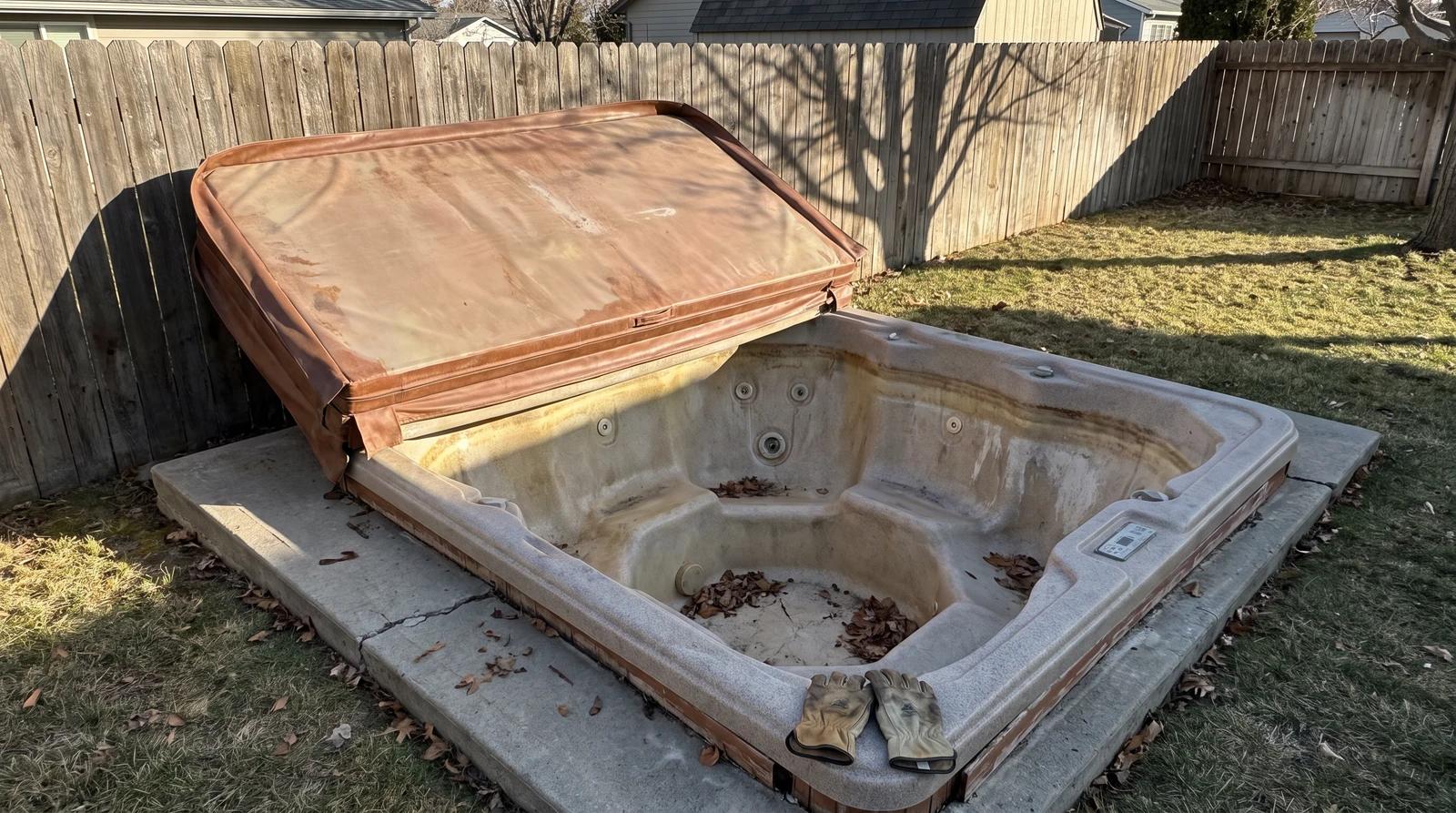
An old unit works against your home when it's broken, empty or plainly headed for the dump.
It doesn't heat, leaks or hasn't been filled in years
You'll read online that even an unused hot tub can positively impact your property value. That can be true when it was drained, covered and winterized properly and still fires right up. More often, an idle one is the problem.
One that hasn't been filled in years often has dried-out seals, cracked plumbing and a soaked or moldy cover. If it won't get hot or it leaks, people count it as a repair or a haul-off, not an amenity.
Heads up: Filling a long-empty one before showings can backfire. If old seals let go and water runs across the pad or deck, that's what people notice.
What's left underneath: the pad, the electrical disconnect and the deck boards
House hunters also think about what the next owner inherits underneath:
- The pad: a slab, pavers or gravel bed that's held a heavy load of hot water for years
- The electrical disconnect: the box on the wall or post and the wiring that fed it
- The deck boards: if it sits on a deck, the wood underneath may be stained, soft or rotted
None of that is a disaster, but it gets people wondering what else they'll be fixing.
How would it ever come out?
Picture a dead unit behind a narrow side gate. Shoppers start wondering how it would ever come out. Does a fence panel come down? Who do you even call?
That worry isn't a line item on an appraisal, but it still makes the house feel like more work.
If it's not helping, what taking it out involves
Taking it out is a fairly contained job. Here's how we run it.
Free on-site estimate and a firm price before anything is touched
We come out, look at the unit, the yard and the path to the street, and give you a firm price before anything is touched. Pricing is based on the space and the work involved, with no hidden fees.
The price moves with size, whether it's built in, how far it's carried and what's in the way. We take cash, card and Venmo, and same-day service is possible when the schedule allows.
Worth asking: If it's hardwired, ask what happens to the wiring afterward. Capping or pulling the circuit back at the panel may be a job for an electrician.
Draining, disconnecting, cutting down or hauling out whole
The order of work stays pretty simple:
- Drain the hot water and let it dry.
- Shut off the power and disconnect it.
- Decide how it leaves. With a wide gate or open side yard, it may go out whole. If it's boxed in by fences or a deck, it gets cut into pieces that fit.
- Carry it out, load it and clean up.
Access moves the timeline most. An open patio near the driveway is the easy version. A raised deck behind a narrow gate on an older North End lot means more cutting and carrying.
Built-in models take more work. Tearing out a concrete or deck surround is demolition, and depending on your city, it may need a permit. We can handle that application for you.
What gets donated or recycled and what's left in the yard
Much of what we haul is donated or recycled. A working unit in decent shape can sometimes go to a new home. Pumps, motors, heaters and metal parts can be recycled.
What nobody can use goes to a local landfill.
What's left in the yard is usually the pad and the electrical box. Steps and other accessories go with the tub. Want the slab gone too? Bring it up at the estimate.
Frequently asked questions
How fast does a portable one lose value?
A portable unit loses value like other big home products, fastest in the early years. Selling an old one or offering it in trade brings little back.
Will putting one in pay for itself?
Adding one can increase appeal for some shoppers, but it rarely earns back what you paid. Buy it because you'll actually sit in the hot water, not as an investment.
Is a swim spa any different?
A swim spa can appeal to buyers who want something close to a pool and turn off the ones who don't. It's much bigger, heavier and has more water to keep hot, so it's a bigger job to remove later.
Should it stay with the sale?
It can, if it's clean, working and wanted. An old or broken one is more likely to come back as a request to remove it before closing.
Keep it or take it out?
If yours runs well and looks cared for, show it off. A spa that's hot and clear on showing day is a positive selling point, and a good one belongs in the listing.
If yours is cold, leaking or just sitting there, taking it out before selling your house takes one worry off the next owner's mind.
The Hot Tub Removal Services page covers what the service includes and how the estimate works.
Related reading: Hot Tub Removal With a Crane: When You Need One and When You Don't and How Do You Remove Water From a Hot Tub Before It's Hauled Away?.
We work across the Treasure Valley, from the Bench and Harris Ranch to Meridian, Eagle, Star, Kuna, Nampa and Caldwell. Call (208) 692-3124 for a free estimate.
Want a Free Quote?
We'll give you an honest estimate for hot tub removal. If DIY makes more sense for your situation, we'll tell you.
Call (208) 692-3124More From Our Blog
How to Dispose of an Old Hot Tub Cover: Cut It Down or Haul It Whole
How to dispose of an old hot tub cover: open the seams, pull the foam and metal, cut it to fit your cart, or leave it on the tub for the removal crew.
How to Remove a Spa: Your Prep and What Hot Tub Removal Services Do
How to remove a spa in Boise: the breaker, water and path you handle before removal day, and what a Treasure Valley crew does from estimate to cleanup.
Can You Take a Hot Tub to the Landfill? What the Trip Takes in Boise
Can you take a hot tub to the landfill near Boise? Learn which county landfill to use, what to ask first, how to prep the tub and what moves the cost.
