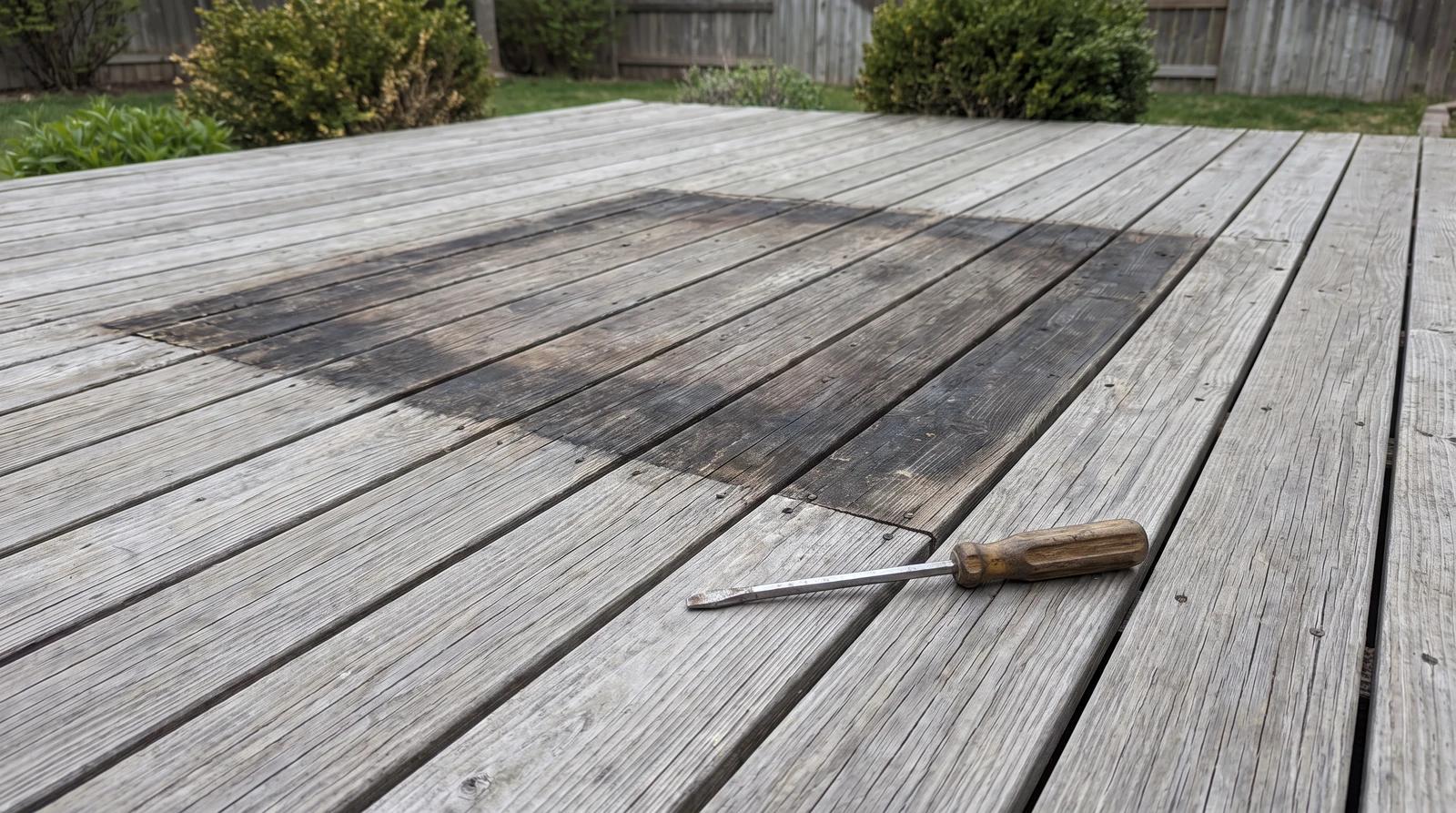
Can an Old Deck Be Restored? How to Restore and Refinish a Wood Deck
Can an old deck be restored? Yes, as long as the posts, joists and ledger underneath are still solid. Gray, splintered or loose boards on top are a surface problem that cleaning, a few swaps, re-nailing and fresh sealant can fix. If the framing is soft or rotted, you're looking at structural repair or a rebuild, no matter how good a fresh coat of stain makes it look.
In Boise and across the Treasure Valley, hot dry summers and freezing winters are hard on wood.
Taking spas off decks shows us what hides underneath, and our advice is simple: judge the deck from the framing up, not the top down.
Can an Old Deck Be Restored, or Is It Past Saving?
Old decking can often be restored even when it looks rough, because weathered gray wood is usually just the top layer. Rot in the framing is a different story.
Check the posts, joists and ledger board first
Start underneath. The posts carry the weight down to the footings, the joists run under the decking, and the ledger is bolted to your house and holds up one side of the whole structure.
Look for:
- Dark, soft or crumbly wood, especially where posts meet the ground or concrete
- Joists that sag, twist or have long cracks
- Rusty or missing bolts and hangers
- Water stains on the ledger, or a gap between it and the house
The ledger is the one to worry about most. When it fails, the deck can pull away from the house. If it's rotted, this isn't a restoration job anymore. It's structural repair or a rebuild.
Heads up: Flashing over the ledger is often missing or rusted out on older decks. If water has run behind it for years, the rot may be hidden on the back side.
Push a screwdriver into soft-looking boards and board ends
Press a flat screwdriver into anything that looks dark or spongy. Sound wood pushes back. Rot lets the tip sink in with little effort, and it may come out wet or stringy.
Pay extra attention to the ends, the spots around nails and screws, and anywhere two pieces butt together. Those areas hold water longest.
A handful of bad boards is normal and easy to swap. Soft spots scattered all over usually mean the joists under them are wet too.
Look under anything heavy that has sat there for years, like a hot tub, planter or grill
This is where a deck hides its worst damage, and a hot tub is the big one. Years of splash, a cover dripping onto the same spot, steam and a very heavy load parked in one place all add up. Air can't get under it, so that spot never fully dries out between seasons.
Planters and grills do a smaller version of the same thing. Move them and look at the footprint. Discoloring, mold, cupping and rusted fasteners are all signs to check the joists right below.
If a spa is still sitting there, take it off before restoring anything. There's no way to judge that spot with a tub on it. And why sand and seal around a tub you might be getting rid of anyway?
What Is the Average Life of a Wooden Deck?
The average life of a wooden deck depends far more on care and climate than on any one number. One that's cleaned and resealed on a regular schedule lasts a lot longer than one that's left bare.
The wood matters too. Cedar and redwood stand up to weather better than untreated pine, and pressure-treated lumber is the usual pick for framing because it resists rot.
A few things shorten it fast:
- Skipped sealing, or old paint left peeling, so water and sun get straight in
- Decking laid tight, so water can't drain
- Framing close to the ground with poor airflow
- Heavy loads that sit in one spot, like a hot tub
In winter, water gets into small cracks, freezes and pushes them wider. A south- or west-facing deck in Meridian or Kuna can gray and check much faster than a shaded one in the North End.
Worn boards can be swapped a few at a time, so a well-built deck doesn't need replacing all at once.
How to Restore a Badly Weathered Deck
Once you know the frame is good, the work goes in a set order. Doing it out of order wastes time and materials.
Clean an old deck without tearing up the wood
Deck cleaning comes first, because you can't see the real condition through dirt, mildew and old gray fibers. Sweep, clear the gaps with a putty knife, then scrub with a cleaner made for decks.
A pressure washer helps, but it's also the fastest way to ruin old wood. Too much pressure, or a tip held too close, cuts grooves and fuzzes up the grain. The best techniques are the gentle ones: a wide fan tip, steady strokes with the grain and plenty of distance. A stiff brush and a garden hose often work fine.
If old paint is flaking, scrape the loose flakes off now so the new sealant has bare wood to grab. Let everything dry fully before the next step.
Swap rotten boards and fix popped nails or screws
Pull any boards that failed the screwdriver test and cut in replacement pieces. Make sure each new board's ends land on a joist. Replacement is also the better fix for a badly split board, since filler underfoot doesn't always hold.
Popped nails are a classic sign of age. Wood shrinks and swells through our seasons, and the nails slowly work loose. Hammered back in, they tend to pop up again. A common fix is to set deck screws just beside the old hole, snugging each board down flat.
Quick tip: Leave a small gap between boards so water drains and air moves. Pieces laid tight trap moisture, which is how a lot of decks started rotting in the first place.
Sand down the splinters and raised grain
Deck sanding takes care of the splinters, raised grain and rough spots that cleaning stirs up. A pole or orbital sander handles most jobs. Don't aim for furniture-smooth, or the stain won't soak in well.
Sweep off all the dust before you move on.
Pick a stain or sealer and seal it on a dry day
The last step is deck staining, which refinishes everything in one pass. Here are your main choices:
| Finish | What it does |
|---|---|
| Clear sealant | Keeps water out and shows the natural grain, with little sun protection |
| Semi-transparent stain | Adds some color and UV protection while the grain still shows |
| Solid stain | Covers like paint and hides worn spots, but can peel |
| Paint | Full color, but traps moisture and peels on walking surfaces |
On old wood, a penetrating stain or sealer usually holds up better than paint or other film-forming coatings, which sit on top and peel wherever feet and furniture wear them down.
Apply it to fully dry wood, out of the hot midday sun, with no rain in the forecast. Two thin coats beat one heavy one, and the label lists the dry times for that product.
Worth asking: Before staining, ask whoever sold the product whether it can go over the old finish. Some stains and paint won't bond unless the old layer is stripped first.
Frequently Asked Questions
What is the cheapest way to redo a deck?
The cheapest way is to clean it, swap only the bad boards, re-fasten what's loose and seal it yourself. It only stays cheap if the framing is sound.
What is the average cost to restore a deck?
What it costs to restore a deck depends on size, how many boards need swapping, whether any framing needs work, and the sealant or paint you choose. Doing it yourself is mostly materials and time. Hiring it out adds labor, and the price climbs if rot turns up underneath.
Is a rotting deck covered by homeowners insurance?
Usually not, since most policies treat rot and wear as upkeep. A sudden event, like a tree falling on it, can be a different story, so check your policy with your agent.
Should a hot tub come off the deck before it's restored?
Yes. The tub sits on the decking and joists most likely to be rotted, and you can't inspect, sand or seal what you can't reach.
Start With What's Under the Tub
So can an old deck be restored? Most of the time, yes. A wood deck that has seen better days can come back as long as the posts, joists and ledger hold up. Check the framing and the footprint of anything heavy, then clean, repair, sand and seal in that order. A careful look underneath will tell you more than a long look at the top.
If there's a spa in the way, Boise Hot Tub Removal takes hot tubs off decks in Boise, Meridian, Eagle, Nampa, Caldwell and the rest of the Treasure Valley. You get a free on-site estimate and a firm price before anything is touched. The estimate looks at the space and the work involved in getting the tub out, and that's what sets the price.
The Deck Services page covers what the service includes and how the estimate works.
Related reading: Hot Tub Removal From a Deck in Boise Under a Pergola and Hot Tub Removal From a Deck in Boise: Crane or Cut and Carry?.
Give us a call at (208) 692-3124 when you're ready.
Want a Free Quote?
We'll give you an honest estimate for hot tub removal. If DIY makes more sense for your situation, we'll tell you.
Call (208) 692-3124More From Our Blog
How to Dispose of an Old Hot Tub Cover: Cut It Down or Haul It Whole
How to dispose of an old hot tub cover: open the seams, pull the foam and metal, cut it to fit your cart, or leave it on the tub for the removal crew.
How to Remove a Spa: Your Prep and What Hot Tub Removal Services Do
How to remove a spa in Boise: the breaker, water and path you handle before removal day, and what a Treasure Valley crew does from estimate to cleanup.
Can You Take a Hot Tub to the Landfill? What the Trip Takes in Boise
Can you take a hot tub to the landfill near Boise? Learn which county landfill to use, what to ask first, how to prep the tub and what moves the cost.
